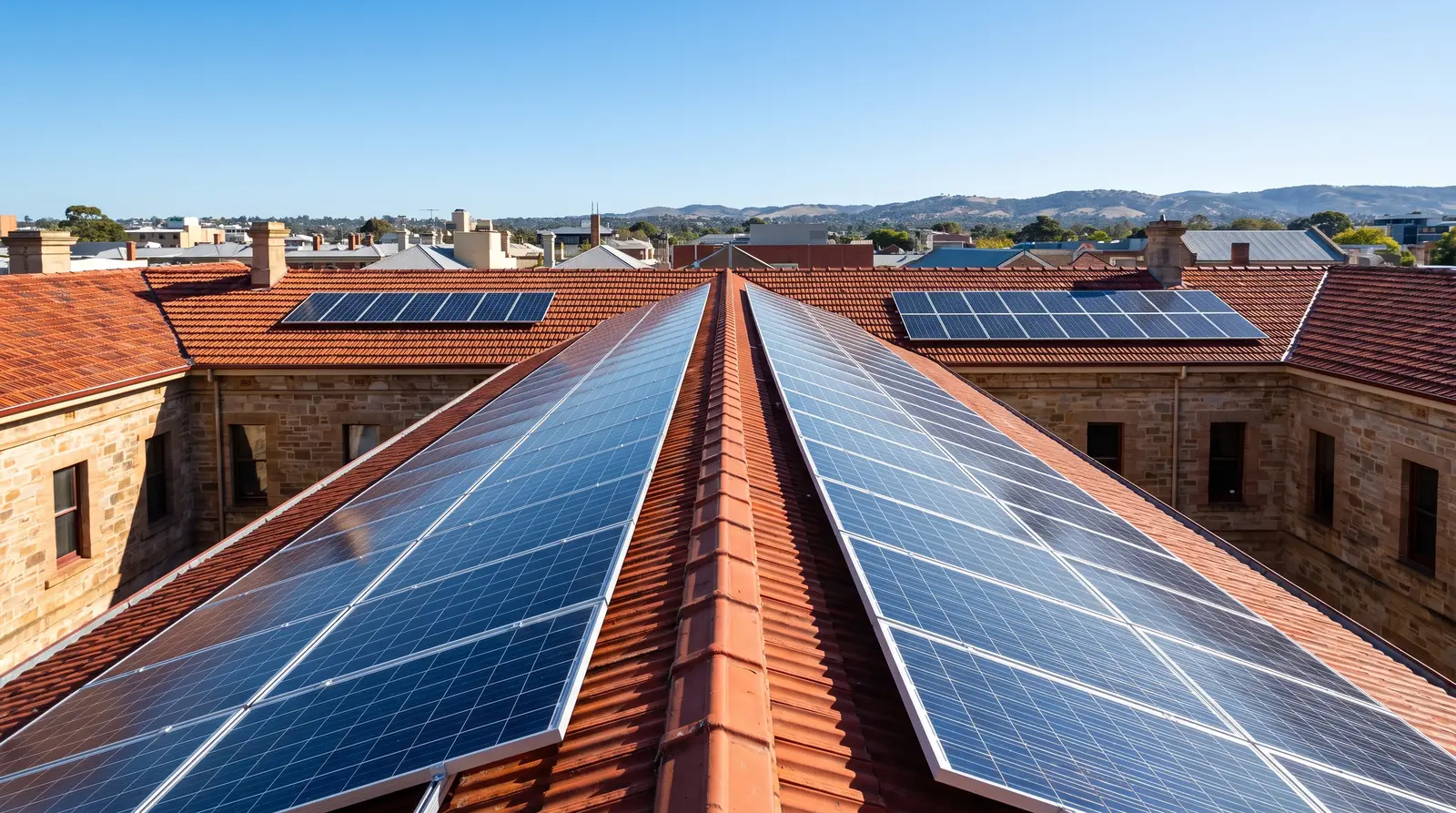
Bird Droppings, Dust and Pollen: What Dirties Adelaide Panels
Adelaide solar panels are dirtied mainly by five things: fine dust and pollen that bake on during dry summers, coastal salt haze near the beaches, bird droppings that shade cells directly, tree debris like leaves and sap under gums, and construction or road dust in the growing northern estates. Dust cuts output evenly, while droppings and debris cause sharp localised losses. All of it is removed the same safe way, with pure or deionised water and soft brushes, never a pressure washer. We connect you with vetted Adelaide operators for free quotes.
Key takeaways
- Dust and pollen bake on in dry summers and cause an even, whole-array loss.
- Coastal salt near Semaphore, Henley Beach and Glenelg forms a sticky film rain does not shift.
- Bird droppings and tree debris shade cells directly and cost more than their size suggests.
- All of it is cleaned safely with deionised water and soft brushes, never high pressure.
Dust and pollen: the everyday film
The most common thing on an Adelaide panel is a fine layer of dust and pollen. Through the long dry summer, airborne dust settles on the glass and there is no rain to rinse it off, so it builds and bonds. Pollen from spring flowering adds a sticky element that helps the dust cling rather than blow away.
This film is the mild case in that it does not usually cause dramatic single-day drops, but it is relentless. Because it covers the whole panel evenly, it trims output across the entire array day after day. Left long enough, an even film becomes a meaningful, ongoing loss that a single clean recovers.
Coastal salt haze
Homes along the coast face a challenge inland suburbs do not: airborne salt. Suburbs like Semaphore, Henley Beach, Grange, Glenelg and Brighton sit in a salt-laden sea breeze, and that salt settles onto glass and forms a haze. Unlike loose dust, salt film is sticky and slightly hygroscopic, so it holds moisture and grips the surface.
The frustrating part for coastal owners is that ordinary rain does not remove it well, and a light shower can smear it. Salt-affected panels usually need cleaning more often than inland ones, which is why coastal homes tend to sit in the twice-a-year camp.
Bird droppings and tree debris: the expensive kind
This is the category that costs the most per square centimetre. Bird droppings are opaque and land in concentrated spots, and because panel cells are wired in series, a single dropping on one cell can drag down the output of the whole string it belongs to. A few well-placed droppings can cost far more production than a whole panel's worth of light dust.
Trees make it worse in two ways. They drop leaves, twigs and sticky sap that block light directly, and they attract the birds that leave the droppings. Homes under or beside gum trees, which are everywhere in Adelaide, cop both problems at once and generally need more frequent cleaning.
- Bird droppings: concentrated, opaque, can knock out a whole cell string.
- Leaves and twigs: direct shading plus trapped moisture that helps lichen take hold.
- Tree sap: sticky, holds dust, and does not rinse off in a shower.
Construction and road dust in the north
Adelaide's northern growth corridor, through estates around Munno Para, Andrews Farm, Angle Vale and Two Wells, means a lot of new homes with solar sitting next to active earthworks and unsealed roads. That generates a steady stream of coarse construction and road dust that settles heavily on nearby panels.
Whatever the source, the fix is the same and it is always gentle. Panels are cleaned with pure or deionised water and soft brushes, never a pressure washer and never harsh chemicals, because high pressure and abrasives damage the glass coating and seals and can void the warranty. We connect you with vetted Adelaide operators who clean the safe way, so you can compare free quotes.