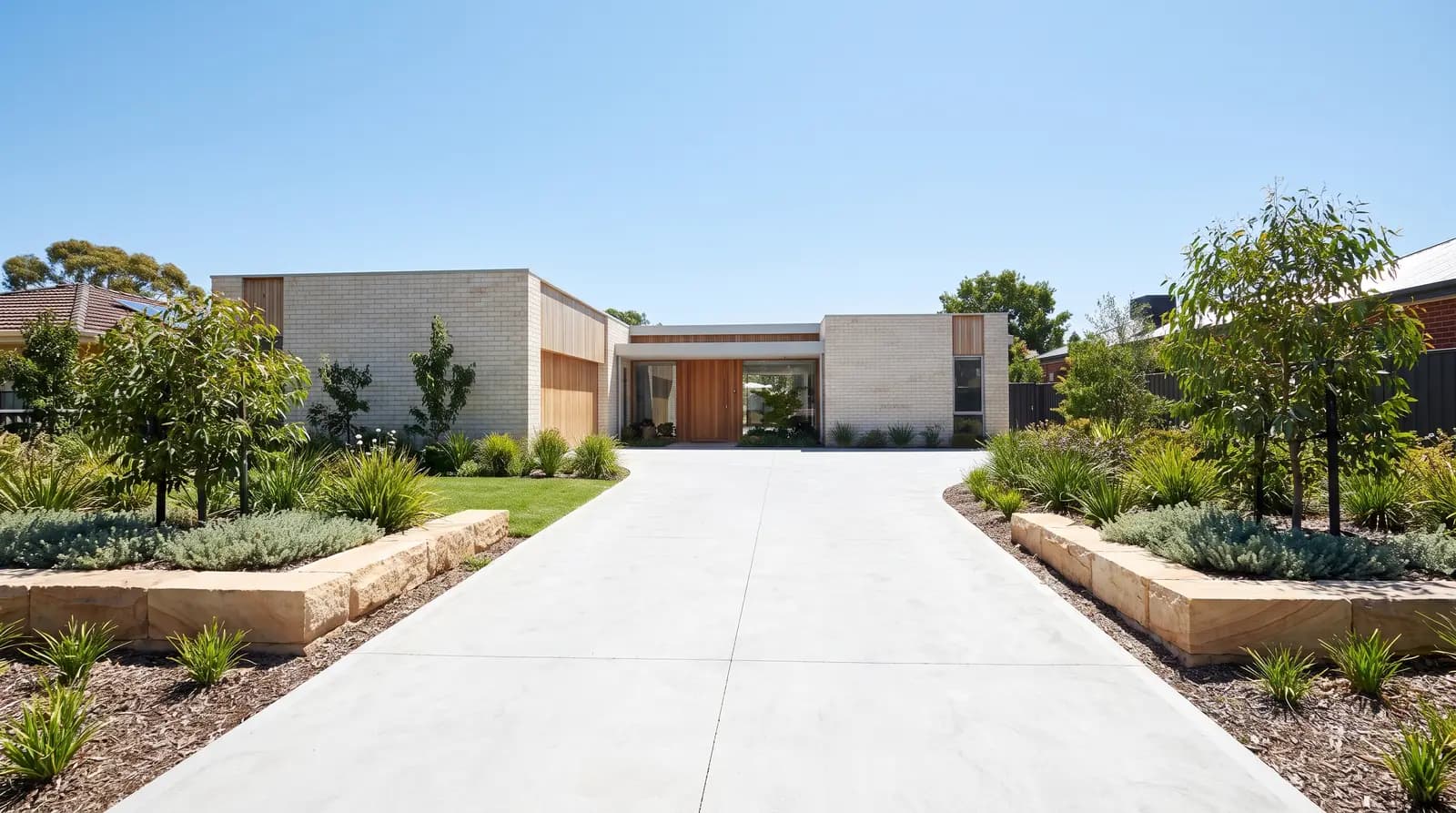
Concrete Cleaning: Sealed vs Unsealed Surfaces
Concrete is the most durable exterior surface and takes genuine high pressure. Unsealed concrete is porous, so it stains and greens up more but cleans up well with pressure and pre-treatment; sealed concrete resists staining and needs a gentler touch so the sealer is not damaged. Plain concrete is more forgiving than exposed aggregate, but deep old oil in porous concrete may lighten rather than vanish. We connect you with vetted Adelaide operators; we never do the work ourselves.
Key takeaways
- Concrete is durable and takes real high pressure, more than aggregate or bluestone.
- Unsealed concrete is porous, stains more, but cleans up well with pressure and pre-treatment.
- Sealed concrete resists staining and needs a gentler touch to protect the sealer.
- Deep old oil in porous concrete may lighten rather than disappear completely.
- We are a referral service connecting you with vetted operators, not a cleaning crew.
Why sealed and unsealed clean differently
Plain concrete is the workhorse of Adelaide driveways, paths and courtyards, and it is the most forgiving hard surface to clean. It takes higher pressure than exposed aggregate, pavers or heritage bluestone without complaint. But whether it is sealed changes the approach.
Unsealed concrete is porous. It drinks up oil, tannins and moisture, which is why it stains, greens up on the shaded side and holds lichen. The upside is that it responds very well to a proper clean: a pre-treatment for organic growth followed by a high-pressure surface cleaner lifts years of grime off it.
Sealed concrete already has a protective layer that resists absorption, so it stains less in the first place. The catch is that the sealer itself can be damaged by too much pressure held too close, so operators ease off to clean the surface without stripping or clouding the seal.
Reading the surface before cleaning
A good operator checks whether concrete is sealed before choosing a pressure and method, because getting it wrong either leaves sealed concrete under-cleaned or strips the seal off. Water beading on the surface, a slight sheen, or a known sealing history are the usual tells.
From there the technique follows the surface. Unsealed concrete can take the full treatment; sealed concrete gets a gentler pass that respects the coating. Organic growth on either is best pre-treated so it lifts chemically rather than being blasted, which is kinder to the surface and gives a more even result.
- Check for sealing first: water beading and sheen are the tells.
- Unsealed concrete takes the full high-pressure treatment.
- Sealed concrete gets a gentler pass to protect the coating.
- Pre-treat moss and lichen on either surface for an even finish.
- Use a surface cleaner for stripe-free results across large slabs.
Cost, stains and honest expectations
Plain concrete sits comfortably in the usual Adelaide bands: roughly $150 to $300 for a single driveway and $250 to $500 for a double or long run. Because it is more forgiving and faster than aggregate, it tends to sit toward the lower part of those ranges for the same area.
On stains, be realistic. General grime, moss and light staining clear well on concrete. Deep old oil that has soaked into porous, unsealed concrete may lighten rather than fully vanish, no matter how good the operator, and honest ones say so before they start. Rust needs its own treatment rather than pressure alone.
If you are cleaning unsealed concrete that stains easily, it is worth asking whether sealing afterwards makes sense to keep it cleaner for longer. Tell us your suburb and surface and we will connect you with vetted operators who read the surface properly and are straight about what will and will not come out.