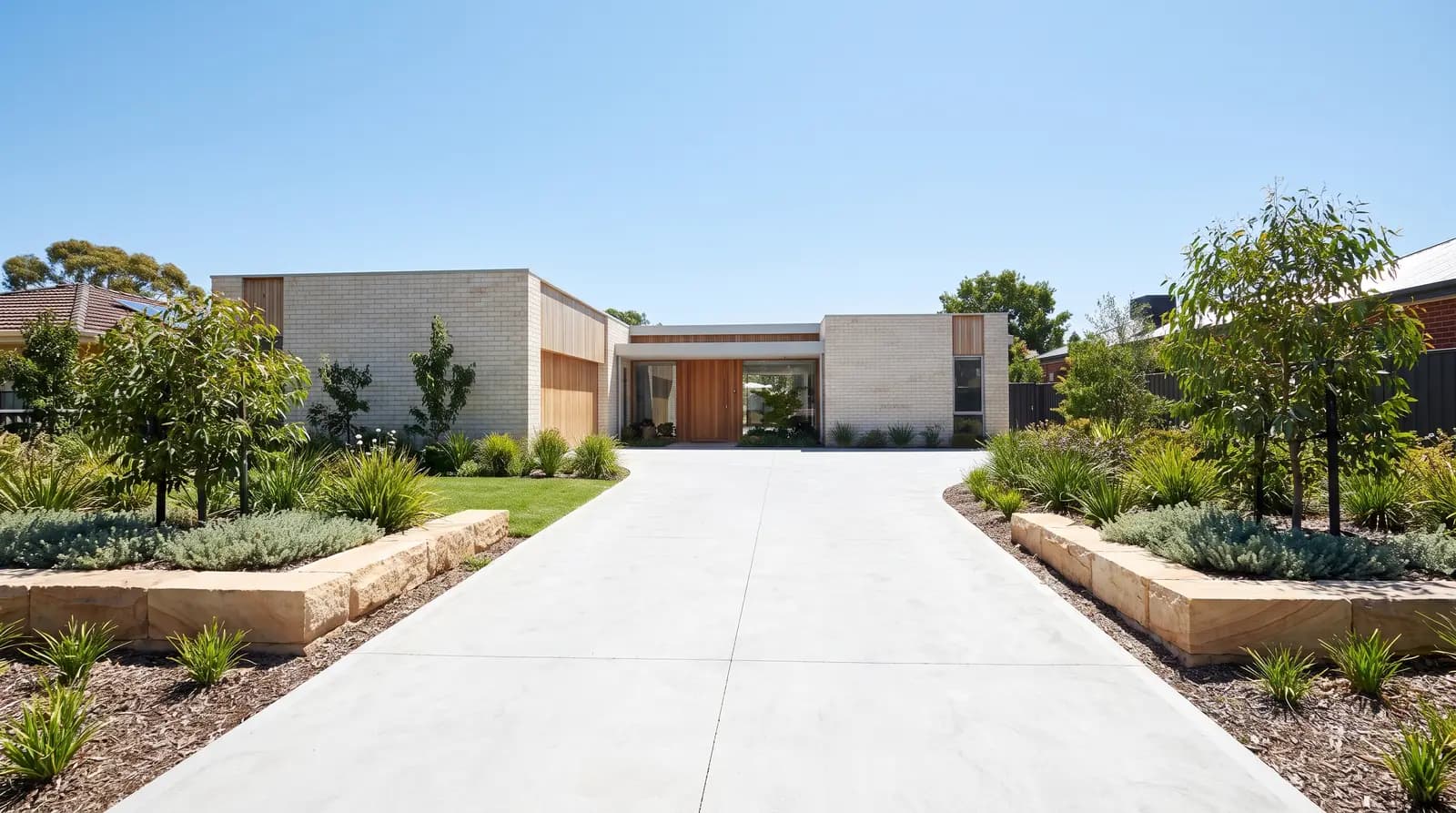
How to Clean Exposed Aggregate Without Damage
Exposed aggregate is cleaned with genuine high pressure, but with more care than plain concrete so the pressure does not dislodge the pebbles or wear away the binder that holds them. Operators keep the surface cleaner moving, use a fan tip rather than a pinpoint jet, and often pre-treat organic growth so they can work at lower pressure. It costs more than plain concrete for the same area, and sealing afterwards keeps it cleaner for longer. We connect you with vetted Adelaide operators; we do not do the work.
Key takeaways
- Exposed aggregate takes high pressure, but needs a lighter touch than plain concrete.
- The risk is dislodging the stones or wearing the binder, which leaves a pitted, patchy finish.
- Fan tips, a moving surface cleaner and pre-treatment let operators clean at safer pressure.
- It costs more than plain concrete for the same area because it is slower and more careful work.
- We are a referral service that connects you with vetted specialists, never the cleaner.
Why aggregate needs more care than concrete
Exposed aggregate is a decorative concrete finish where the top layer of cement paste is washed off during curing to reveal the stones underneath. It is popular across newer Adelaide estates because it looks smart and grips well, but that exposed-stone surface is exactly what makes cleaning it trickier.
The pebbles are held by the surrounding cement binder. Hit that binder with too much concentrated pressure, held too close or too long in one spot, and you start wearing it away and popping stones loose. Once a patch of aggregate loses its stones it never looks right again, and repair is difficult and obvious.
So aggregate sits in an awkward middle ground: it is a hard surface that genuinely takes high pressure, but not the same brute-force approach you can use on a plain concrete slab. The technique is what keeps it safe.
How operators clean it safely
The safe approach starts before the pressure. A pre-treatment that kills moss, lichen and algae does a lot of the work chemically, which means the operator can lift the loosened growth at a lower, safer pressure instead of blasting it off cold.
For the pressure itself, a rotating surface cleaner held flat keeps an even distance and never lingers in one spot, which is far kinder to aggregate than a hand-held lance. Where a lance is needed for edges, a wider fan tip spreads the force instead of a pinpoint jet that can carve into the binder.
- Pre-treat organic growth so it lifts at lower pressure.
- Use a rotating surface cleaner kept moving and held flat.
- Fan tips, not pinpoint jets, on any hand lance work.
- Keep the nozzle at a sensible distance, never bored into one spot.
- Work methodically so the finish is even, not patchy.
Cost and the case for sealing
Because aggregate is slower and needs more care, it costs more than plain concrete of the same size. Within the usual Adelaide bands of $150 to $300 for a single driveway and $250 to $500 for a double, aggregate tends to sit toward the upper part of the range.
Sealing is worth serious thought on aggregate. The textured, pebbly surface traps dirt and holds moisture, so it greens up and stains more readily than smooth concrete. A penetrating sealer resists that staining, slows moss and weed regrowth, and makes future cleans faster and gentler, which protects the surface over its life.
Sealing is an extra cost and needs a dry surface, so it is usually a separate visit. Whether it pays off depends on your driveway, and a good operator will give you a straight answer rather than adding it by default.